Project Margin Rescue
Which active project requires intervention now to protect margin, cash timing or delivery economics?
Why current systems fall short.
- Project identity and economics are fragmented across budget, actual, time, WIP, billing, forecast and contract systems.
- Point forecasts hide the range and timing of possible margin outcomes.
- Variance reports do not choose a feasible intervention under real owner capacity.
- Predicted risk is routinely confused with the causal effect of an action.
The records it reads.
Each system stays the authority for its own facts. The engine lines up identities, units and dates at the same decision cutoff and shows where they conflict.
- 01ERP and project accounting
- 02PSA and timekeeping
- 03Billing, AR and WIP
- 04Procurement and supplier cost
- 05PMO, contract and forecast history
What each part of the engine does.
Forecasts are settled before the options are scored. Permissions and hard constraints always take priority.
| Component | Job | Effect on the decision |
|---|---|---|
| Machine learning | Forecast remaining cost, the distribution of margin at completion, the timing and type of a breach, and the probability that an action will be completed. | Sets the forecast used to compare the options |
| Rules and constraints | Match records, enforce authority, currency, lifecycle and contract rules, and provide the fallback when a model cannot be used. | Removes actions that are not allowed or not feasible |
| Optimisation | Choose which permitted project actions receive limited PMO and owner capacity. | Chooses the set of actions to take |
Actions it recommends.
Each recommendation names one action, its target, owner and deadline, the constraints it respects and the evidence that shows it was done.
- 01Revise the estimate to complete for a named project
- 02Issue an eligible milestone invoice against its billing event
- 03Submit a change order backed by the contract evidence
- 04Request a correction to a named supplier cost
- 05Hold an intervention, with a set trigger to review it again
How value is measured
Tracks the original exposure, the portion the action can affect, the expected effect, completion, observed outcome, verification and finance recognition separately for each project and time window.
Inside your operation.
The engine runs in a dedicated AWS account or your own infrastructure, connects to your systems and uses models calibrated on your records.
- Decision grain
- Every active project, at each weekly cutoff
- Connected systems
- ERP, project accounting, timekeeping, billing and procurement
- Approval
- Every action is approved before it changes a source system
From the product build, shown with sample data.
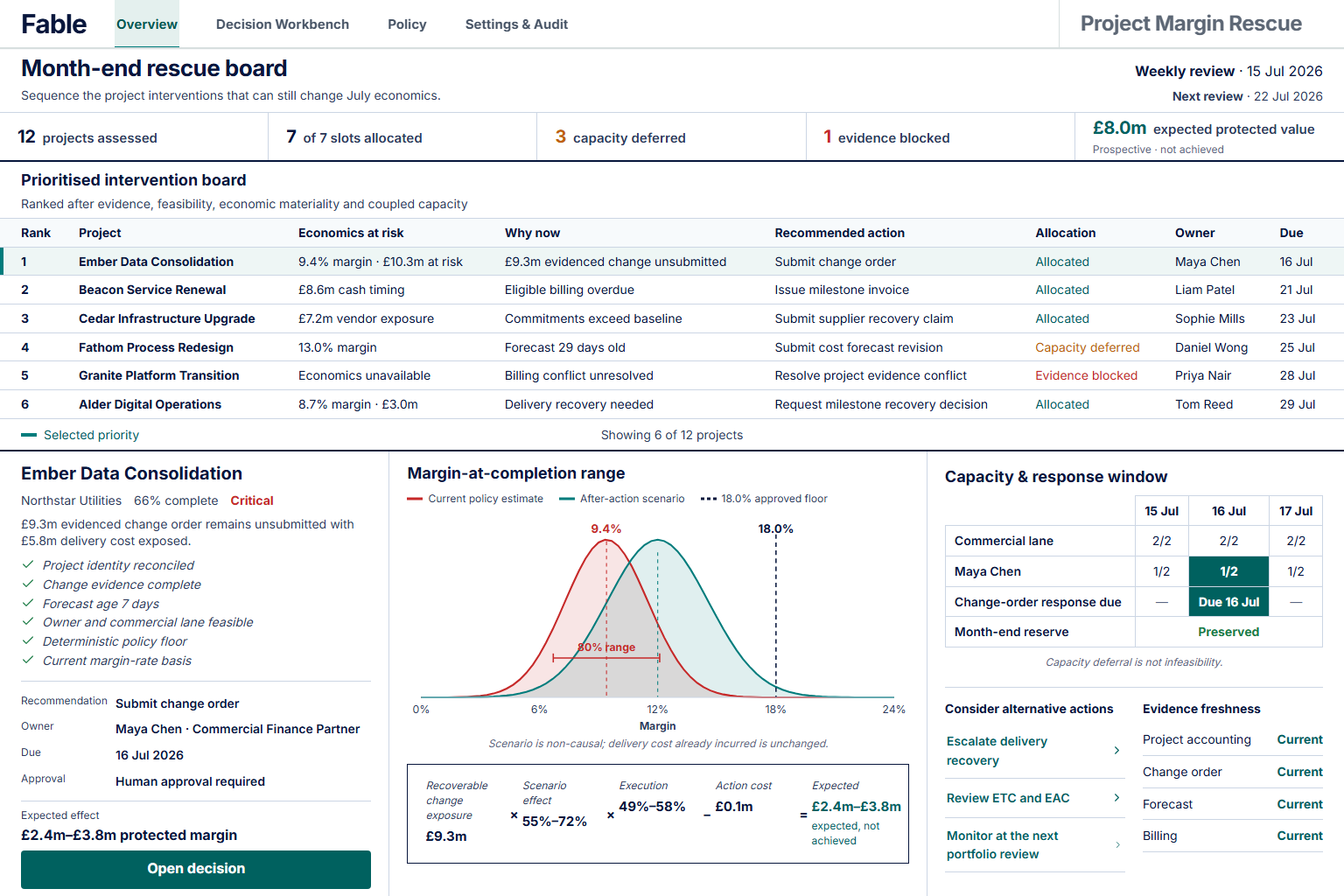
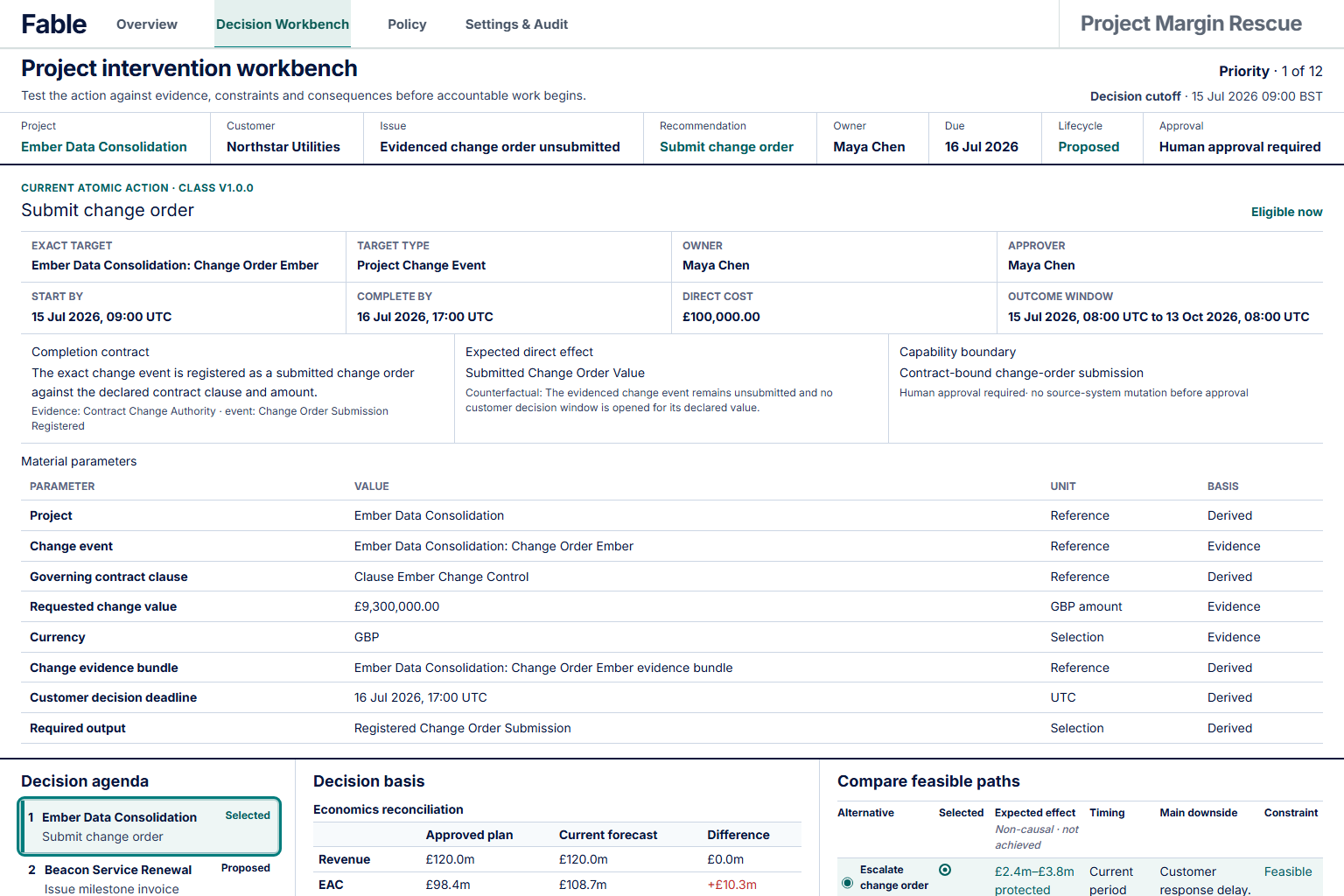
What the opportunity assessment checks.
Can the available project history improve the weekly choice of intervention, and can finance verify the result?
What we need to see
- Reliable project identity across forecast, actual, time, WIP and billing
- Historical cutoff-safe project outcomes and forecast versions
- A named project-control owner and intervention authority
- A finance-recognisable margin, cash or write-off outcome
When we would stop
- Project economics or identities cannot be reconciled reliably
- The leakage is not controllable by a named operating owner
- No finance-recognisable outcome or measurement path exists
Qualify this decision in your operation.
The opportunity assessment looks at your historical records, the actions available, who has authority to act and the value at stake, before a pilot begins.
Book a live walkthrough